Many employers assume that if misconduct is obvious, the outcome will take care of itself. A recent ERA decision serves as a timely reminder that even serious concerns about employee conduct do not excuse an employer from following a fair and reasonable process.
H&S Breach but Flawed Process
Despite an established serious breach of health and safety requirements, the employer’s handling of the investigation resulted in a finding that it had breached its duty of good faith and an award of $18,000 compensation to the employee.
Well-intentioned employers can still find themselves facing a successful personal grievance if their investigation and disciplinary processes are not handled correctly. A recent Employment Relations Authority (ERA) decision highlights how procedural missteps can undermine an otherwise legitimate employment process.
Background:
Mr. Colyer was employed by New Zealand Aluminum Smelters Limited (NZAS) as an electrician for 19 years until he resigned in October 2024. The resignation came after a disciplinary process arising from a workplace safety incident, which he later challenged in the ERA, while also claiming he was constructively dismissed.
On 28 August 2024, Mr. Colyer was called to inspect a gantry crane that had stopped operating. During the inspection, he failed to isolate a nearby 35-tonne crane before accessing the gantry crane. Concerns were also raised about whether he had worn the required personal protective equipment (PPE) when later isolating the crane.
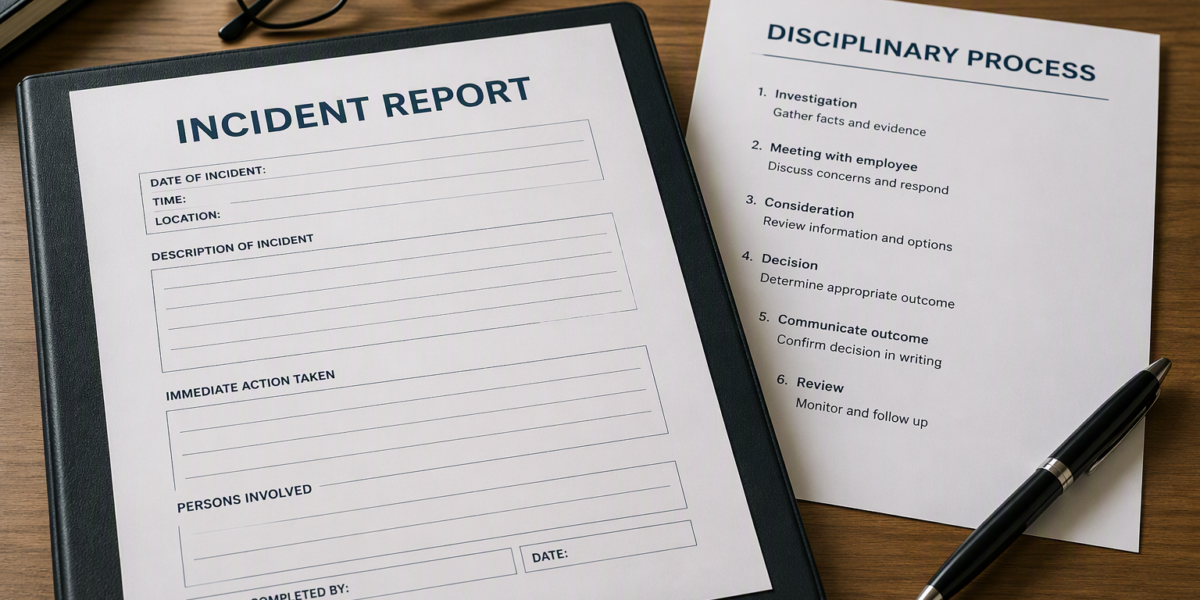
An incident report was completed the following day and NZAS commenced an investigation, which ultimately led to a disciplinary process and a written warning. However, the Authority found that the way the matter was managed was procedurally flawed. In particular, the employer’s process blurred the distinction between an incident investigation and a disciplinary process, relied on matters that had not been fully investigated, and created concerns about whether the outcome had been predetermined.
Mr. Colyer was unsuccessful in establishing constructive dismissal, as the ERA concluded that while the breaches of duty by NZAS were serious to warrant resignation by Mr. Coyler. However, the ERA was not convinced that it was foreseeable that he would resign in response to the unjustified disciplinary process. This is because Mr. Coyler had accepted that a formal warning was an appropriate outcome.
Mr Coyler, was however, successful in his personal grievance for unjustified disadvantage. The Authority found that the warning resulted from an unjustified disciplinary process and ordered NZAS to pay $18,000 compensation for humiliation, loss of dignity, and injury to feelings.
This case is a useful reminder that having a genuine reason to investigate is only the starting point. Employers must also ensure the process that follows is fair, clearly communicated, and supported by the evidence.
The Authority’s criticisms centered on several common mistakes:
- Failing to clearly distinguish between an incident investigation and a disciplinary process.
- Allowing concerns to evolve during the process without properly investigating and putting those concerns to the employee.
- Not gathering all relevant evidence before moving to disciplinary action.
- Failing to provide the employee with all relevant information before the disciplinary meeting.
- Failing to provide the employee with all relevant information before the disciplinary meeting.
Employment investigations and disciplinary processes often involve procedural nuances that are easy to overlook but can have significant consequences if challenged. Seeking expert advice early can help ensure concerns are properly investigated; allegations are framed appropriately, and the process remains fair, defensible, and compliant with an employer’s good faith obligations.
Related Posts